Academic research is a complex process that involves gathering, analyzing, and interpreting vast amounts of data. Researchers often face challenges such as information overload, time-consuming literature reviews, and difficulty identifying relevant studies. These best AI tools for academic research are game-changing in the research arena as they provide automated approaches to streamlining research tasks. For example summarize long research papers, find appropriate sources, bringing a significant revolution in academic research.
These tools will save lot more time with effortless, create better, more accurate, and highly productive results. From automation and analysis to providing insightful summaries, AI in research has made a big difference. In this article offers some of the best ways every researcher should use AI. Not only does it save time, but the quality of research is also enhanced. Now, Let’s explore how these AI-powered assistants will revolutionize academic research.
Best AI Tools for Academic Research in 2025
1. PDFGPT
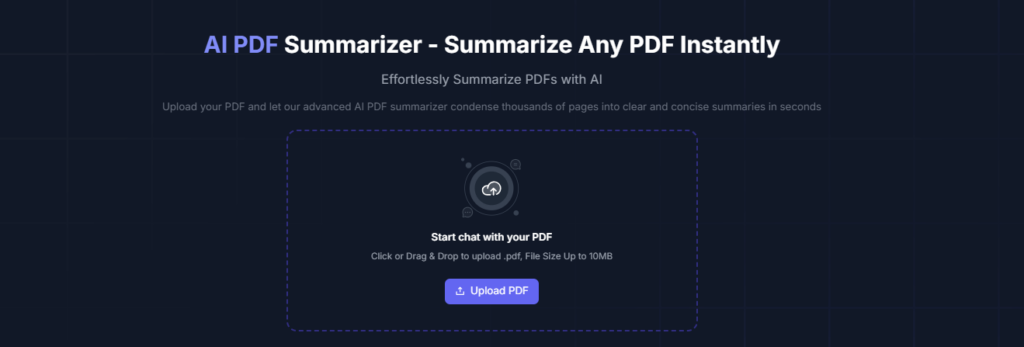
Reading and analyzing research papers can sometimes become difficult, especially when dealing with many long PDFs to scroll through. With PDFGPT, an AI PDF summarizer, scholars can interact with their research papers using AI, facilitating the process. Users can upload PDFs and ask questions about their contents, enabling the extraction of significant insights.
Instead of manually searching PDFs for answers, scholars get instant summaries and clarifications. PDFGPT can thus assist with literature reviews by summarizing critical points and findings. It can also help researchers in decoding complex jargon used in academic papers.
However, PDFGPT ensures that scholars do not miss out on essential details while skimming through research papers. This allows researchers to access relevant information by increasing research efficacy quickly. Scholars can try PDFGPT for their academic research, for free, to deal with growing volumes of academic literature.
2. Semantic Scholar

With vast amount of published material, finding the right academic papers for research can be challenging. Semantic Scholar is an AI-powered search engine designed to help scholars discover relevant studies efficiently.
It can analyze research papers and provide more intelligent search results. Instead of simply matching keywords, it understands the context behind queries and returns papers that are most relevant in meaning. A significant highlight of this tool is citation analysis, which helps researchers ascertain the impact and credibility of studies.
Scholars can also use its recommendation system to find related papers based on their research interests. Semantic Scholar speeds up the literature review process by filtering high-quality research and providing intelligent suggestions. This tool prevent scholars from missing out on other key studies in their area for anyone who doesn’t want to be left behind with current research trends.
3. Research Rabbit

Research Rabbit represents the next stage of literature discovery, with a visual component to research papers. Instead of providing lists of academic research papers, it helps create an interactive citation map that allows scholars to see connections in their studies. Thus, this visual network assists in tracking citations, related work, and the moving trends of research.
By following specific research topics, users will receive auto-updates on new papers in their field. The tool thus effectively organizes work, thereby boosting research efficiency. Research Rabbit allows users to develop their paper collection in an organized and systematic order.
It helps them identify landmark papers and key researchers in the field. In this manner, the AI-assisted discovery process ensures that scholars do not miss out on pertinent research. This tool also comes in handy for systematic literature reviews and academic networking.
4. Elicit

Research Elicit is an AI system that automates literature surveys and knowledge discovery. Rather than searching for papers independently, researchers can pose questions about their own study, and Elicit retrieves studies pertinent to providing answers.
It can scan through thousands of research publications, extracting valuable insights within seconds. The results highlight the critical findings, methodology, and summary of academic papers in a manner that allows scholars to digest the needed information quickly. By automating the rest of the research, Elicit saves time and increases research productivity. It also identifies gaps in the literature, which help scholars to cre research questions.
Researchers can use it to compare studies, analyze inconsistent results, and find useful patterns. Elicit’s AI-based functionality ensures researchers receive the most relevant and credible information. It is a great working partner for any academic research.
5. Scite
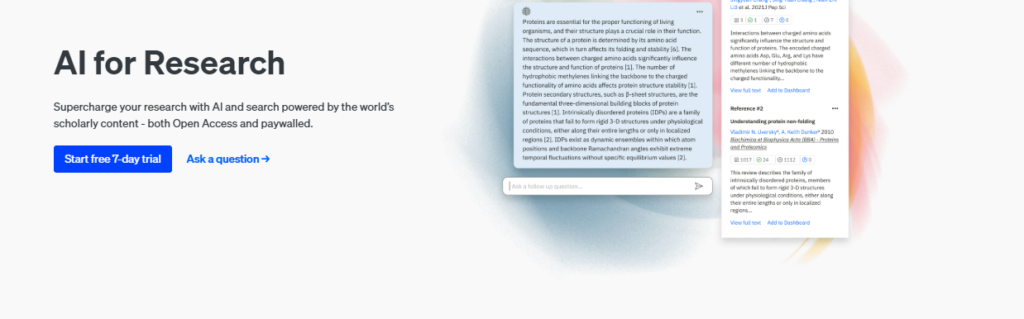
Research papers is part of academic development; however, equally important is validating the sources noted. Scite has built on citation analysis through Smart Citations. Instead of just showing how often a paper has been cited, it analyzes whether citations support or contradict the research.
In this way, researchers can check the study’s strength before including it in their works. By identifying well-supported evidence, Scite helps authors build their papers on solid footing; it also helps identify opposing proof, which is important for critical examination.
The AI mechanism analyzes citations not just for counting purposes but also to add contextual meaning, thus enhancing the quality of research and preventing misguidance through fake references. Scite is indispensable for any scholar trying to strengthen his or her claim in any research community.
6. HyperWrite

Academic research requires scholars to spend a vast amount of time identifying the information, analyzing complex topics, and writing compelling papers. HyperWrite is an AI writing assistant that enhances research productivity by providing intelligent writing suggestions, summarizing sources, and improving clarity.
HyperWrite helps scholars to refine research papers by detecting grammar errors, rephrasing awkward sentences, and ensuring a polished academic tone. One of its essential features is building summaries and insights about research materials, saving precious time for scholars.
It also help researchers to structure arguments so that the research paper remains rational and coherent. HyperWrite is also a tool that scholars can use to brainstorm ideas and get AI-generated suggestions for literature reviews or thesis development. It offers invaluable assistance by significantly resolving the workload concerning research and writing. HyperWrite is a significant AI assistant for scholars seeking help drafting articles, summarizing sources, or enhancing writing.
Conclusion
AI has taken the academic research world by storm, providing automating repetitive processes and expediting knowledge discovery. The above six AI tools, PDFGPT, Semantic Scholar, Research Rabbit, Elicit, Scite, and HyperWrite, give researchers powerful new means to make research easier.
These tools allow scholars to direct their attention toward higher-order processes, such as deep analysis and reduce time on getting insights and task. AI research assistants complement efficiency with higher standards of work, it provides an even more brilliant solution for the identified gap in scholastic research. However, this tools will undoubtedly help researchers put the finishing touches to their work. To make research effective scholars can harness this tools to stay ahead of the game.